
Most advice about the OpenClaw skills marketplace treats it like a convenience layer. Browse a catalog, install a skill, gain a new capability. That framing is incomplete and, in production, dangerous.
A skills marketplace for autonomous agents isn't just a feature library. It's a software supply chain attached to systems that can act, connect, and execute. If you're a founder, agency principal, or operator, the key question isn't whether OpenClaw skills are powerful. It's whether your team can adopt them without turning governance into an afterthought.
The right way to think about this category is simple. Capability is easy to add. Trust is hard to earn. The organizations that succeed are the ones that treat skill adoption like controlled infrastructure, not like casual experimentation. That means privacy boundaries, auditable changes, and clear operating rules from day one. If your operating model doesn't already account for those concerns, start with a stronger baseline around privacy-first AI operations.
Table of Contents
- The Power and Peril of the AI Skills Marketplace
- What Is an OpenClaw Skills Marketplace
- The Technical Architecture of Skills and ClawHub
- Why Governance and Security Are Non-Negotiable
- Enabling Secure Marketplace Workflows with Donely
- Monetization Patterns and Real-World Use Cases
- Your OpenClaw Skills Adoption Checklist
The Power and Peril of the AI Skills Marketplace
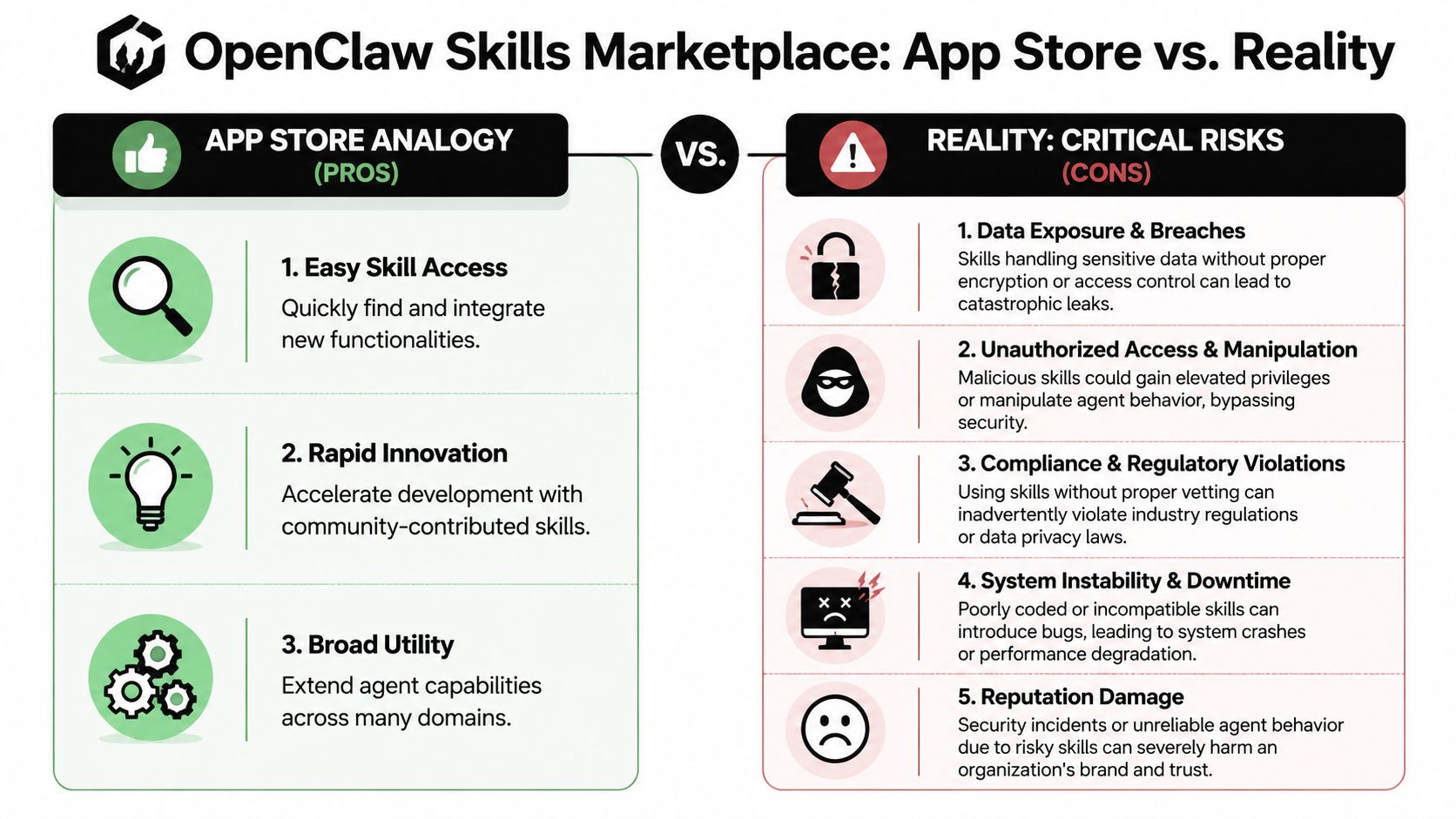
Calling the OpenClaw skills marketplace an app store for agents is useful for orientation, but it's bad operating advice. App stores imply a consumer trust model. Agent skills sit much closer to automation modules that may touch credentials, external services, and internal workflows.
That's why the same thing that makes the marketplace attractive also makes it risky. You can expand an agent quickly, but every added capability changes the system's attack surface, maintenance burden, and failure modes. A team that installs skills freely often discovers too late that it also imported new review requirements, policy questions, and runtime exposure.
Capability compounds faster than control
The appeal is obvious. Skills let a general-purpose agent become task-specific without rewriting core logic. That's great for speed. It's less great when nobody owns approval rules, publisher vetting, environment scoping, or rollback.
In practice, I see two common mistakes:
- Treating discovery as governance: Finding a useful skill isn't the same as approving it for production.
- Assuming popularity equals safety: Community traction can help discovery, but it doesn't replace technical review.
- Letting one successful test become a deployment standard: A skill that works in a sandbox may still be wrong for client data, regulated data, or shared team environments.
Practical rule: If a skill can change what an agent can access or execute, it belongs in your governance process, not just your prompt workflow.
The business issue is operational trust
Founders usually start by asking what skills can do. Agencies ask how fast they can deploy them across clients. Both are asking the wrong first question. The first question is who owns the risk if the skill behaves badly, breaks a workflow, or exposes something sensitive.
That shift matters because the OpenClaw skills marketplace isn't just a product feature. It's a distribution channel for capability, and distributed capability always creates uneven quality. The upside is speed. The downside is that speed pressures teams to skip controls they later need.
What Is an OpenClaw Skills Marketplace
An OpenClaw skills marketplace is the catalog layer for extending what an OpenClaw agent can do. If the agent is a general-purpose worker, a skill is a packaged capability that adds a narrower function, such as search, communication, automation, development support, or a workflow step.
A simple mental model
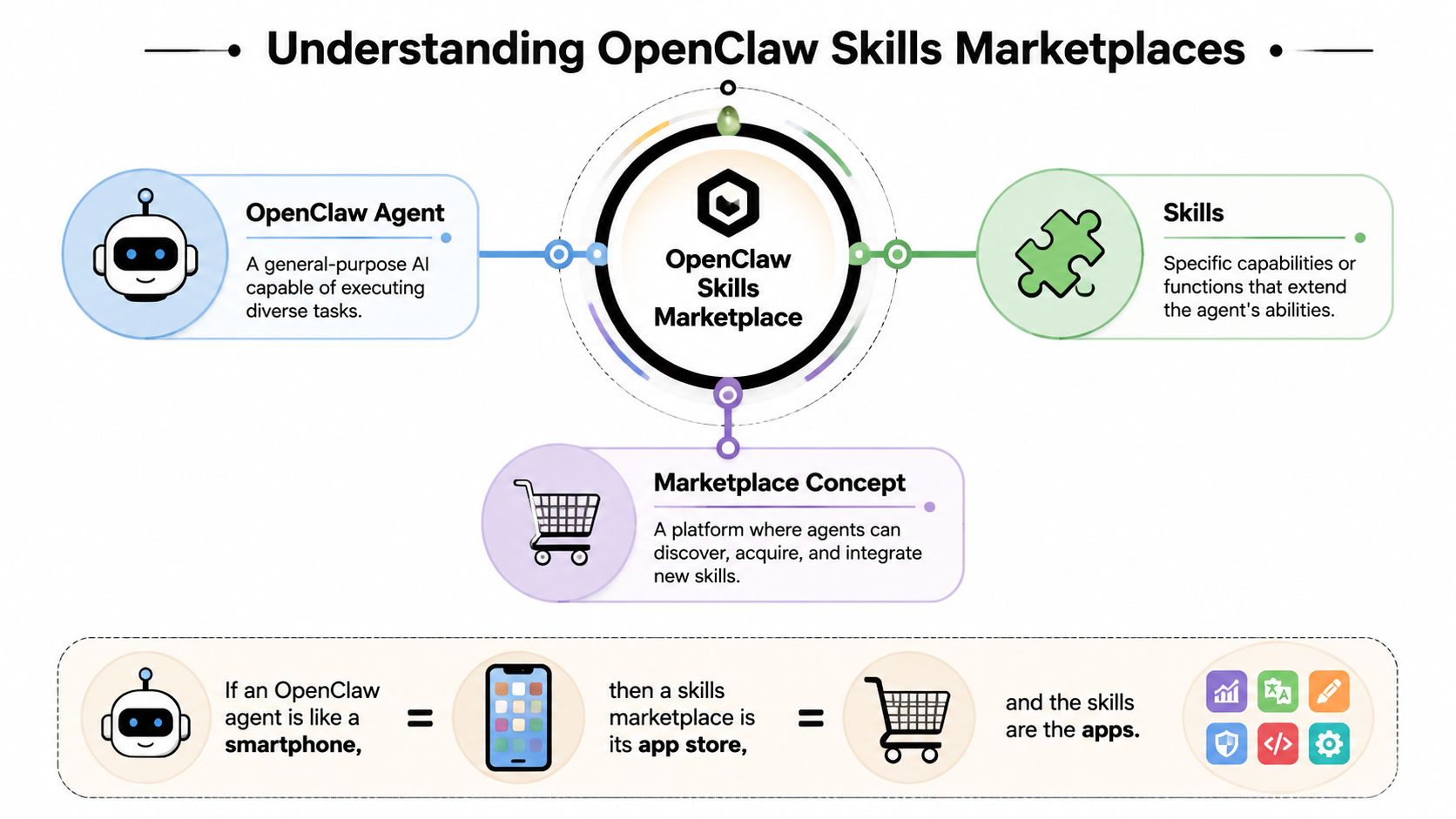
The cleanest analogy is this. If an OpenClaw agent is like a smartphone, the marketplace is its app store, and the skills are the apps. That analogy works as long as you remember one important difference. These "apps" may participate in agent execution flows, not just user-facing convenience.
The marketplace matters because it separates the agent core from the long tail of capabilities. Instead of hardcoding every possible behavior into OpenClaw itself, the ecosystem can publish capabilities as installable units. That's why marketplaces tend to expand quickly once the base platform gets traction.
A 2026 roundup reported that ClawHub had surpassed 10,000 community-built skills by March 2026, alongside 53 first-party skills bundled natively, and that the underlying OpenClaw project had reached more than 190,000 GitHub stars. The same roundup framed that breadth as a major signal of ecosystem adoption because users could choose from productivity, development, automation, search, communication, and smart-home skills rather than a tiny curated set, according to Growexx's OpenClaw skills roundup.
For operators, that scale changes the nature of selection. You're no longer choosing from a neat official menu. You're navigating abundance, duplication, and uneven maturity.
Why scale changes the management problem
A large marketplace is good for experimentation. It's harder on procurement discipline. The more options a team has, the more likely it is to install overlapping tools that do similar things with different trust assumptions.
That challenge isn't unique to agents. Teams that build marketplaces or marketplace-like product surfaces already know that discovery, quality control, and lifecycle management become the hard part long after launch. If you want a product-side perspective on how marketplaces mature beyond listing pages, AppStarter marketplace app expertise is a useful reference.
For a practical OpenClaw deployment view, the cleaner framing is to separate three layers:
| Layer | What it does | Common mistake |
|---|---|---|
| Agent | General reasoning and execution | Giving it broad access too early |
| Skill | Adds a specific capability | Assuming installable means safe |
| Marketplace | Discovery and distribution | Treating distribution as approval |
Teams evaluating the OpenClaw ecosystem usually need this distinction before they need more feature lists. That's also why serious implementations often start with a controlled platform model rather than direct raw experimentation across every available listing, especially when using managed OpenClaw environments.
The Technical Architecture of Skills and ClawHub
The architecture behind the OpenClaw skills marketplace is one reason adoption feels fast. Skills aren't bolt-on ideas in a forum thread. They're packaged capabilities that the agent can load as discrete units.
How a skill is packaged
OpenClaw skills use a modular, self-contained capability model. Each skill packages instructions and any supporting assets into a unit the agent can install and use without rewriting core agent logic, as described in Tencent Cloud's OpenClaw technical overview.
That packaging model matters because it changes implementation from custom integration work to a more standardized deployment step. Instead of adding one-off code paths for every new function, the agent can load capabilities in a repeatable way. Skills can also be chained, which is where simple tool use starts becoming workflow composition.
A practical way to think about the lifecycle looks like this:
- Package the capability as a discrete skill with its instructions and assets.
- Publish or register it so it can be discovered and installed.
- Load it into an agent workspace with the right configuration.
- Inject only the required environment context so the skill can operate.
- Control usage through gating or allowlisting when the environment is shared.
Skills reduce integration friction because they move capability delivery into a consistent packaging model. They also shift risk into packaging review, workspace controls, and runtime boundaries.
Why the architecture matters operationally
This modularity is why OpenClaw can scale across many use cases, but it's also why operators need discipline. Standardized packaging makes deployment easier. It also makes replication easier, which means a questionable skill can spread through teams faster if nobody controls approvals.
The technical controls mentioned in OpenClaw documentation are worth paying attention to. Skills can be gated, allowlisted, and environment-injected per workspace. Those aren't minor implementation details. They are the difference between isolated capability loading and a messy shared environment.
In multi-agent setups, I look for three things first:
- Workspace isolation: Skills shouldn't automatically inherit access across unrelated workloads.
- Scoped environment injection: A skill should only receive the variables and credentials it needs.
- Approval boundaries: Installation and execution shouldn't be governed by the same loose rule.
If you run OpenClaw seriously, hosting architecture becomes part of the skill strategy. Teams that skip this usually end up rebuilding controls later around segmentation, auditing, and drift. That's why many operators move quickly toward OpenClaw hosting designed for isolated workloads instead of treating every agent as a single shared sandbox.
Why Governance and Security Are Non-Negotiable
The biggest mistake teams make with the OpenClaw skills marketplace is assuming that capability review is mostly about usefulness. In production, usefulness is the easy part. The harder part is deciding whether a skill deserves trust, how much trust it deserves, and what happens if that trust was misplaced.
The core risk isn't the marketplace homepage
Independent reporting has identified over 230 malicious skills in the ecosystem, and one publisher cluster included 314 malicious skills from a single account, according to AuthMind's analysis of malicious OpenClaw skills. That same reporting points out why this matters operationally. Skills can execute code, access environment variables, make external calls, and use prompt injection to influence agent behavior.
Those are not edge-case concerns. That's the normal shape of agent extensibility. Once you accept that, the security model changes. You're no longer vetting a passive add-on. You're vetting a unit that may influence actions, reach systems, and interact with data under your credentials.
A second reporting stream reached a similar technical conclusion from a different angle. Socket reported that VirusTotal analyzed 3,016 OpenClaw skills and found hundreds with malicious characteristics, including staged downloads and external payload execution, with one cluster containing 314 malicious skills from a single publisher account, in Socket's ClawHub malware investigation.
What automated scanning does and doesn't solve
OpenClaw did add a meaningful control when it partnered with VirusTotal for marketplace scanning. In that announcement, OpenClaw said published skills are scanned asynchronously, benign skills are auto-approved, suspicious skills receive warnings, malicious skills are blocked from download, and users can inspect the full VirusTotal report on each skill page, as described in OpenClaw's VirusTotal partnership announcement.
That matters. It shows the marketplace has moved into governed distribution rather than pure open upload. But scanning isn't a substitute for runtime policy.
Teams still need their own control stack because a skill can be harmless at rest and risky in behavior. A setup step, external fetch, or permission assumption can turn a clean-looking package into an operational problem.
Use this test internally:
| Question | Why it matters |
|---|---|
| Who published this skill? | Publisher identity affects trust and escalation paths |
| What does it need access to? | Permissions define blast radius |
| What external actions can it trigger? | Network calls and execution paths raise supply-chain risk |
| How do we observe it after deployment? | You need logs, not assumptions |
Security stance: Marketplace scanning is helpful. Production approval still belongs to the team that owns the environment, the data, and the incident response burden.
Enabling Secure Marketplace Workflows with Donely
The hard part of an OpenClaw skills marketplace is not discovery. It is controlled adoption at runtime, across teams, clients, and agents that do not share the same trust boundary.
Teams that get real value from marketplace skills usually add an operating layer around them. Without that layer, every new skill becomes a custom exception. Approval lives in chat, credentials spread too far, logs fragment across environments, and nobody is fully sure which agent can do what.
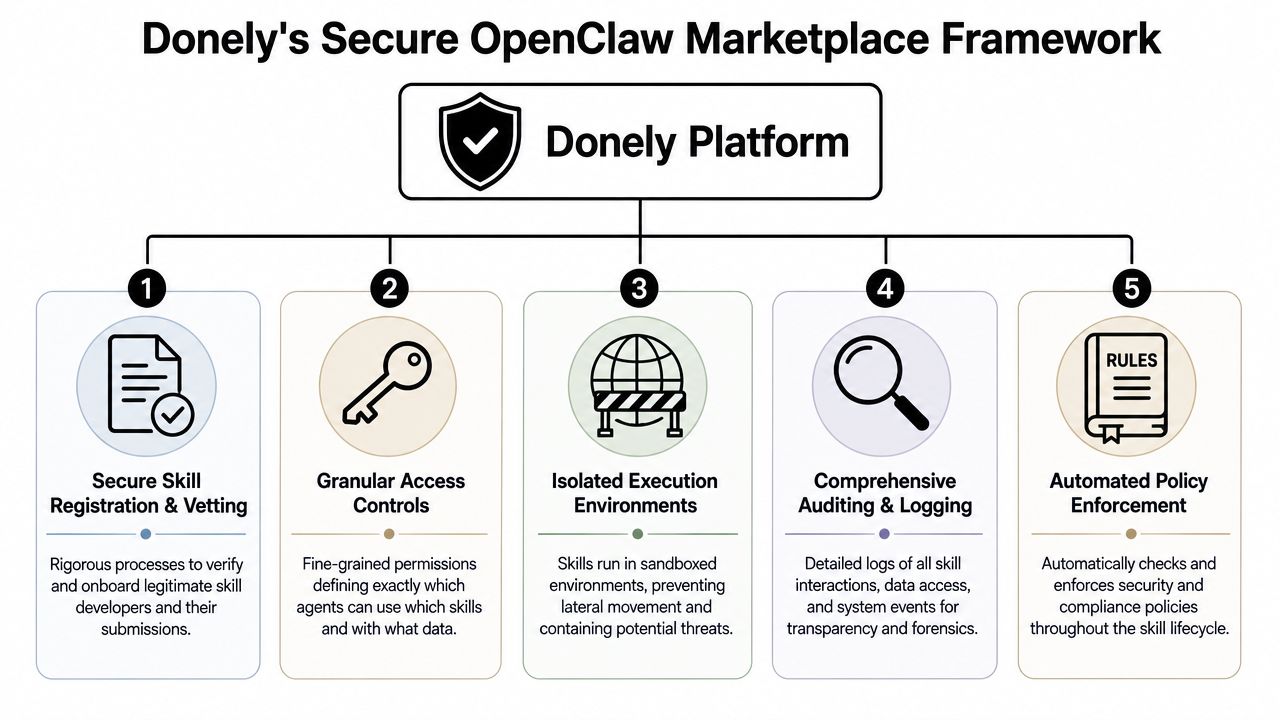
A workable model is less glamorous than the marketplace itself. It relies on controls that are easy to audit and hard to bypass:
- Isolated workloads: Client environments, internal operations, and test agents need separate execution boundaries.
- Granular access control: Publishing, approving, installing, and observing skills should be separate permissions.
- Scoped secrets and data boundaries: Skills should receive only the credentials and context required for the task at hand.
- Audit logs: Teams need a record of who approved a skill, where it ran, and what it touched.
- Centralized monitoring: Runtime drift, unexpected calls, and failed executions usually show up after deployment.
The marketplace often proves to be the point where many OpenClaw rollouts either mature or stall. The marketplace can distribute skills. It does not solve tenancy design, approval routing, incident response, or day-two operations.
That is the gap Donely addresses. It gives teams a managed way to run OpenClaw across isolated instances with per-instance RBAC, scoped data access, unified audit logs, centralized monitoring, and consolidated billing. For an agency principal, that means one client workspace does not inadvertently inherit another client's tools or data exposure. For a technical founder, it means skill adoption can scale without turning platform operations into a permission mess.
The multi-agent angle matters most. In shared environments, one agent may be customer-facing, another may support internal ops, and a third may test new skills. Treating those agents as if they belong in the same runtime is how small governance mistakes become production incidents.
The operating pattern that holds up is straightforward:
- Create separate instances by risk profile and ownership. Split production, staging, internal operations, and client work.
- Assign approvals to named roles. Do not fold skill review into broad admin access.
- Use allowlists for production agents. Experimental skills should not be available everywhere by default.
- Monitor at the instance level. Logs are only useful if you can trace actions back to a clear runtime boundary.
- Centralize billing and status reporting. Cost sprawl and operational sprawl usually arrive together.
I have seen teams try to manage this with shared containers and informal review. It works for a week. Then a client asks for audit evidence, a skill needs emergency removal, or two teams discover they were relying on the same secret scope for different reasons.
A production-ready marketplace workflow answers four questions quickly: who approved the skill, where it runs, what it can access, and how to disable it without collateral damage.
That is the practical difference between experimenting with marketplace skills and turning them into a governed service layer.
Monetization Patterns and Real-World Use Cases
The OpenClaw skills marketplace creates two different business questions. One is how creators make money. The other is how buyers decide whether a skill is worth operationalizing.
Where creators actually make money
Most creators won't build lasting businesses from novelty skills. The more durable opportunities usually sit around workflow ownership, integration depth, and implementation services.
In practice, the monetization patterns that make sense are:
- Direct paid access to a specialized skill when it solves a narrow, recurring task.
- Subscription access to maintained workflow skills where updates and compatibility matter.
- Implementation and customization services for teams that need the skill adapted to their environment.
- Bundled operational packages where the skill is only one piece of a larger deployment offer.
The key is maintenance credibility. A skill isn't valuable because it exists. It's valuable when it keeps working, keeps fitting the target stack, and keeps its trust profile intact.
Use cases that hold up in production
Public discussion around OpenClaw often over-indexes on feature demos. Operators need repeatable workflows instead. A public roundup noted more than 4,000 OpenClaw skills cataloged by community trackers and argued that the marketplace will continue expanding, but that many skills will be redundant, many will disappear, and only a small number will become foundational, according to Solve with AI's OpenClaw skills analysis.
That lines up with what teams see on the ground. The skills that survive are usually workflow-layer capabilities, not flashy one-off wrappers.
Examples that tend to justify adoption:
- Sales operations workflows: Enrich a lead, route context into a CRM, draft follow-up material, and log the activity trail for review.
- Support triage flows: Classify inbound requests, gather account context, draft responses, and escalate based on defined rules.
- Internal operations automation: Move structured information between systems like Slack, Notion, Jira, and ticketing tools with approval checkpoints.
- Agency client delivery: Run isolated automations per client without mixing credentials, prompts, or reporting.
The wrong selection method is "install whatever looks useful." A better filter is this:
| Selection question | Strong signal |
|---|---|
| Does it support a recurring workflow? | Repeated use beats novelty |
| Is the publisher identifiable? | Accountability matters |
| Can the team verify maintenance? | Production value depends on upkeep |
| Does it fit existing systems? | Compatibility beats feature count |
The businesses that get ROI from the OpenClaw skills marketplace usually pick fewer skills than expected. They just pick the ones that fit real operating loops.
Your OpenClaw Skills Adoption Checklist
The safest way to adopt the OpenClaw skills marketplace is to make every new skill pass through the same review path. Not a heroic manual process. A standard one.
A practical review sequence
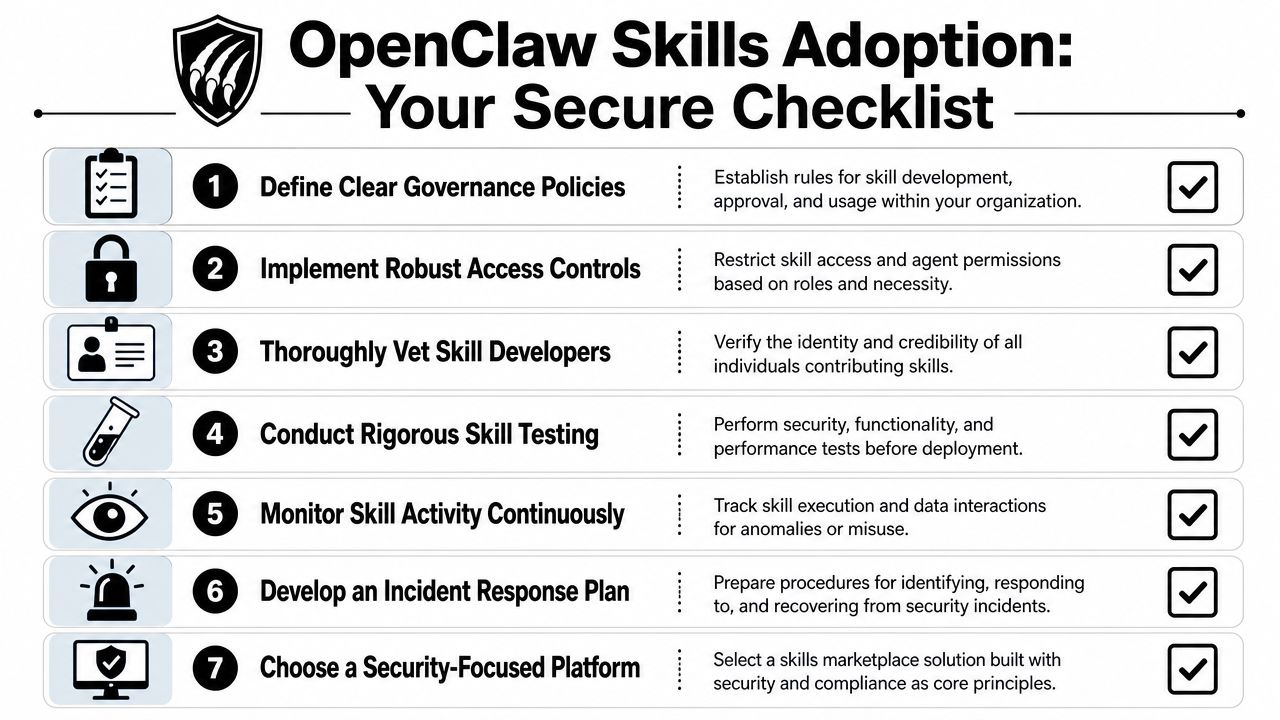
Use this checklist before a skill reaches production:
- Start with the workflow, not the catalog. Define the exact business job the skill is supposed to improve. If the use case is fuzzy, the approval decision will be fuzzy too.
- Verify publisher identity. If you can't determine who built it and how they maintain it, treat the skill as untrusted.
- Review capability scope. Check what the skill can execute, what systems it touches, and whether it requires environment variables or external calls.
- Limit access before testing. Put the skill in a controlled workspace with the smallest possible permission set.
- Test behavior, not just installation. A clean install doesn't prove safe runtime behavior. Run realistic tasks and inspect outputs, calls, and logs.
- Define an owner. Every approved skill needs someone responsible for updates, exceptions, and retirement decisions.
- Use allowlists in production. Don't let production agents browse the full world of available skills unless you have a reason and a review process.
- Log and monitor continuously. Approval is the start of management, not the end.
- Plan the rollback path early. Know how to disable the skill, revoke related access, and investigate impact if something goes wrong.
A good marketplace process feels slightly stricter than a demo team wants and much lighter than an incident review requires.
If you're a founder, keep the standard simple enough to use. If you're an agency, make it client-safe by default. If you're running multi-agent operations, optimize for isolation, auditability, and revocation speed.
If you're moving from experiments to governed deployment, Donely is worth evaluating as the operational layer around OpenClaw. It gives teams a way to run separate instances, control access by role, isolate execution, and keep monitoring and audit trails in one place so marketplace adoption doesn't outgrow the team's ability to manage it.