
You're probably looking at the same fork in the road many teams hit after their first successful AI automation demo.
A developer wires an agent into Slack or Telegram, proves it can answer questions, maybe even handle a few repetitive workflows, and then the core requirement becomes apparent. The agent can't just work when someone remembers to start it. It needs to stay available, react to outside systems, keep context, and survive restarts. That's where the openclaw vs Claude Code Channels decision becomes less about features and more about operating model.
Both tools address the always-on agent problem, but they do it from very different assumptions. One assumes you want a persistent, self-hosted runtime you control. The other assumes you already live inside Claude Code and want a faster way to connect that session to messaging channels. That difference changes architecture, deployment, governance, and cost.
Teams often ask the wrong first question. They ask which one is better. The useful question is narrower. Do you need a continuously running agent runtime, or do you need a lightweight remote-control layer for work already happening in Claude Code? Post-April 2026, that question matters even more because the pricing and access path changed for OpenClaw workflows, which means sticker-price comparisons are now misleading.
Table of Contents
- The Modern AI Agent Dilemma
- Core Architecture and Design Philosophy
- Feature and Capability Deep Dive
- Developer Experience and Deployment
- Security Governance and Observability
- Comparing Cost Licensing and TCO
- Use Cases and Final Recommendations
The Modern AI Agent Dilemma
The common requirement sounds simple. “We want an AI agent to watch support tickets, respond in Slack, and keep working overnight.”
The implementation is where teams get stuck. A local coding assistant can complete tasks well enough. A chat-connected bot can answer prompts from Telegram or Discord. But neither result automatically gives you an operational agent system that can monitor events continuously, maintain context across time, and trigger work without a human opening a laptop first.
That's why OpenClaw and Claude Code Channels keep getting compared. They overlap at the surface because both connect AI-driven workflows to external channels. Underneath, they solve different layers of the problem.
One is built around persistent operation. The other is built around fast interaction with an already running Claude Code session. If your team misses that distinction, you'll choose based on demo appeal and regret it during deployment.
A founder running a lean product team usually cares about speed. They want something working this afternoon. A platform team inside a larger company usually cares about control, separation of workloads, and predictable operations. Those are not the same buying criteria.
Practical rule: If the agent must keep watching the world when no developer is present, treat runtime persistence as a first-class requirement, not a nice-to-have.
The openclaw vs Claude Code Channels comparison only gets useful when you frame it that way. Claude Code Channels can be the right answer for event-driven developer workflows. OpenClaw can be the right answer for autonomous monitoring and longer-running operational agents. The rest of the decision comes down to what that architectural split does to setup time, security ownership, and total cost.
| Criteria | OpenClaw | Claude Code Channels | What it means operationally |
|---|---|---|---|
| Primary model | Persistent self-hosted agent runtime | Remote-control layer for Claude Code | One is built to keep running, one is built to connect to a running session |
| Best fit | Continuous monitoring and autonomy | Fast channel access for developer workflows | The use case decides the winner |
| Setup profile | More infrastructure work upfront | Faster time-to-working | Simplicity and flexibility trade off directly |
| Control | High infrastructure ownership | More managed workflow inside Claude ecosystem | Governance choices follow the operating model |
| Cost shape | Software is free, but infrastructure and API use matter | Subscription-centered entry point | TCO depends on usage pattern and ops burden |
Core Architecture and Design Philosophy
The architecture gap is the whole story.
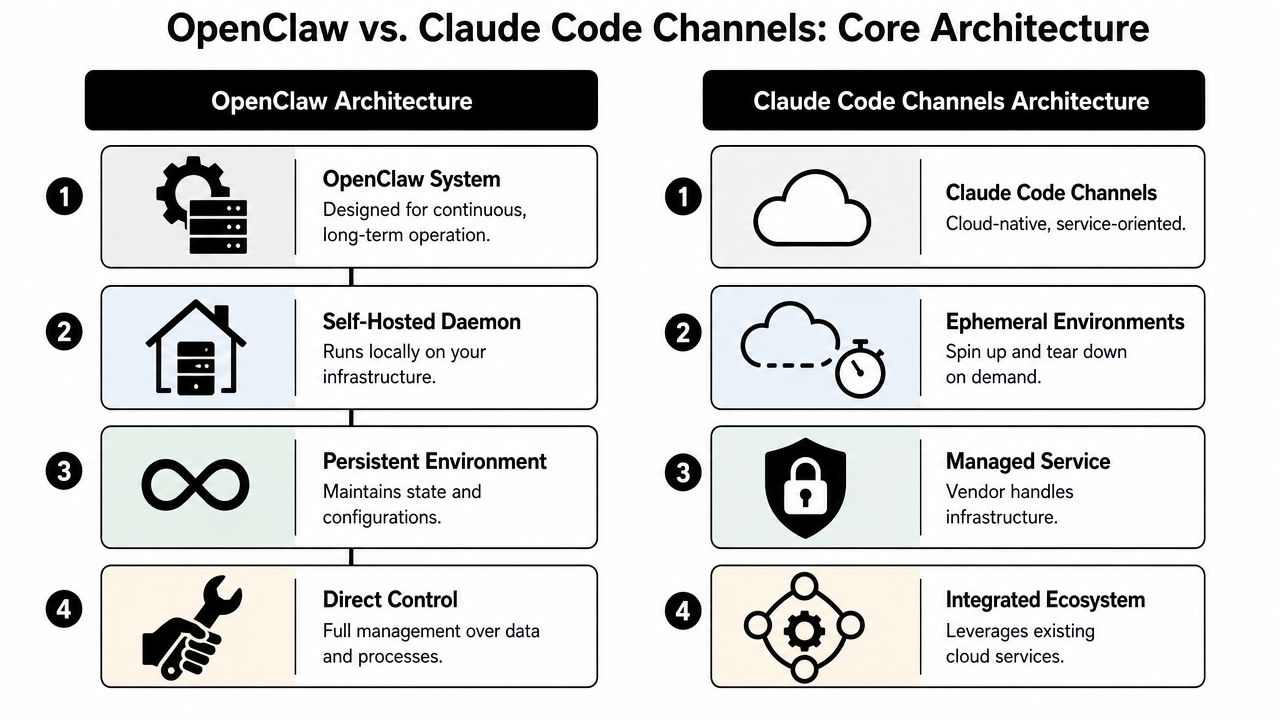
OpenClaw is described as a long-running background daemon with a Gateway that maintains open WebSocket connections to apps like Discord, Slack, and WhatsApp. Claude Code Channels is described as a short-lived, event-driven process that launches, runs, and exits after each task, and it works best when Claude Code is already running locally. That comparison is laid out in ByteByteGo's analysis of Claude Code vs OpenClaw design differences.
Two different definitions of always on
OpenClaw embodies an “always on” state. The runtime stays alive. It can monitor, wait, route, and act over time. That makes sense for workflows like inbox triage, support monitoring, scheduled checks, and multi-step automations that need continuity.
Claude Code Channels treats “always on” more like reachable on demand. The channel gives you a way to talk to an existing Claude Code session from tools like Telegram or Discord, but the model is still event-driven. That's a strong fit for software tasks where a developer wants quick remote access to a coding context or headless automation path, especially in CI/CD-oriented workflows.
A useful analogy is this:
- OpenClaw is closer to an on-call operator already sitting in the control room.
- Claude Code Channels is closer to a pager connected to a specialist who has to be available in an existing environment.
Both can solve real work. They just fail in different ways.
What the runtime model changes in practice
Once you accept the runtime difference, the trade-offs become predictable.
OpenClaw's model supports the pieces teams usually discover they need after deployment:
- External triggers through webhook support
- Persistent memory through memory backends
- Continuous execution through a long-running loop
- Broader operational autonomy across business workflows
Claude Code Channels keeps the path shorter if your main goal is fast developer access from a remote channel. That's why it often feels simpler in early testing. You aren't standing up a separate agent server. You're extending a workflow you already have.
A team should choose architecture based on failure mode. If the worst-case outcome is “the session wasn't running,” Channels may be fine. If the worst-case outcome is “the agent stopped monitoring production work,” a persistent runtime matters more.
This is also why the products attract different operators. Teams with infrastructure maturity usually value ownership and flexibility. Individual developers often value the shortest path to a working result. If you want a managed path around self-hosting complexity while staying close to the OpenClaw operating model, Donely's OpenClaw deployment approach is one example of how the market is trying to close that gap.
Feature and Capability Deep Dive
Features only make sense in context. A checklist without deployment assumptions usually leads teams to overvalue edge capabilities and undervalue workflow fit.
Below is the comparison I'd use in an architecture review.
OpenClaw vs Claude Code Channels Feature Comparison
| Feature | OpenClaw | Claude Code Channels | Key Takeaway |
|---|---|---|---|
| Execution model | Long-running background runtime | Event-driven interaction with an existing Claude Code session | Persistence is the biggest differentiator |
| Channel connectivity | Gateway-based connections to external apps | Connects messaging channels into Claude Code | Both connect outward, but through different operating models |
| Autonomy style | Continuous monitoring and autonomous decision-making | Reactive task execution | OpenClaw suits unattended workflows better |
| Memory approach | Supports persistent memory backends | Relies on the active Claude Code context | Long-lived context favors OpenClaw |
| Triggering | Supports webhook triggers and persistent execution loop | Best when events reach a running local workflow | OpenClaw handles external automation patterns more naturally |
| Workflow focus | General operational agents and business workflows | Strongest for software-development automation, including headless and CI/CD setups | Claude Code Channels is narrower, but very effective in its lane |
| Infrastructure ownership | Self-hosted and controlled by the team | Tied to Claude Code and Anthropic access model | Governance requirements may decide this before features do |
| Multi-agent posture | Better fit for self-hosted multi-agent control | Less infrastructure-flexible | Teams planning multi-agent operations usually lean OpenClaw |
| Time-to-working | More setup work | Faster to stand up | Speed favors Channels |
| Scaling posture | Better aligned with longer-running operational setups | Better for simpler remote control of existing sessions | Scale is about runtime form, not just user count |
Where each one feels stronger
Claude Code Channels feels strong when the workflow starts with a developer. Someone already has Claude Code open, wants to connect Telegram or Discord, and needs a low-friction bridge. That's a clean use case. It avoids a lot of platform engineering before value appears.
OpenClaw feels strong when the workflow starts with the business process. A queue needs watching. A support inbox needs triage. A status check must happen whether or not anyone sends a message first. In those scenarios, persistent execution matters more than convenience.
There's also a practical split around control. OpenClaw is repeatedly characterized as open source, self-hostable, and better suited to organizations that want infrastructure ownership, especially regulated teams or those with stronger DevOps capacity. Claude Code Channels benefits teams already paying for Claude because it lowers setup friction and keeps the workflow close to the commercial CLI environment, as outlined in Eigent's OpenClaw vs Claude Code comparison.
The tool that feels simpler in a demo isn't always simpler in production. It's often just deferring a different kind of complexity.
If your requirements document includes terms like scheduled execution, external triggers, persistent memory, and multi-agent routing, OpenClaw maps more directly to the problem. If it includes “remote access to my coding workflow from chat,” Claude Code Channels usually maps faster.
Developer Experience and Deployment
Developer experience is where teams feel the trade-off immediately.
Claude Code Channels usually wins the first hour. It plugs Telegram or Discord into an existing Claude Code session, which makes it the lower-friction path and ranks higher on “time-to-working,” while OpenClaw is the stronger option for self-hosted multi-agent control and longer-running setups, according to MindStudio's comparison of Claude Code Channels and OpenClaw for mobile agent control.
How setup feels on day one
For an individual developer, Channels tends to feel straightforward because the path is incremental. You already have Claude Code. You connect a channel. You test messages. You confirm the session responds. That sequence is psychologically important because every step produces visible progress.
OpenClaw asks for a different mindset. You're not just enabling a feature. You're establishing a runtime. That means thinking about hosting, process reliability, secrets management, logs, and how the agent should recover after interruptions. None of that is impossible. It just isn't “plug in and go.”
A practical setup review usually looks like this:
- Need fast validation. Channels is easier to prove out.
- Need unattended execution. OpenClaw matches the requirement better.
- Need multiple isolated agent workloads. Self-hosted patterns become more attractive.
- Need less ops burden while preserving an OpenClaw-style deployment model. A managed hosting path such as Donely OpenClaw hosting becomes relevant.
What changes when you move to production
Many comparisons tend to stop too early.
One working agent is not the same as a deployable agent system. Once teams move beyond a prototype, they need to answer less glamorous questions:
- How do we restart failed workers cleanly
- How do we separate one client's agent from another
- How do we observe stuck runs versus slow runs
- How do we patch and upgrade without breaking the workflow
- How do we support more than one agent without turning the host into a snowflake
OpenClaw creates more room for operational design, which is exactly why more of the burden lands on the operator. You gain flexibility, but you also inherit more deployment responsibility.
A good walkthrough of what people bump into during implementation is below.
Claude Code Channels narrows the deployment surface area. That's often a benefit. But the trade-off is that you're operating inside a less infrastructure-flexible pattern. For developer-centric automation, that can be exactly right. For business-critical, always-running agents, teams usually end up wanting a more explicit runtime layer.
Security Governance and Observability
Security decisions in this category are mostly about where control lives.
With OpenClaw, the team controls infrastructure, data paths, runtime placement, and operational boundaries. That's a major advantage for organizations that care about data residency, custom isolation, and tighter internal governance. It's also a major responsibility, because self-hosting doesn't grant security. It grants the ability to implement security well or poorly.
Control versus responsibility
Self-hosted systems help when the organization needs to decide exactly where workloads run and how data is segmented. That matters in regulated environments, internal operations, and agency models where client separation is a contractual expectation rather than a preference.
Claude Code Channels sits inside Anthropic's broader ecosystem, which means the platform carries more of the infrastructure burden. That reduces operational effort for the team using it. The trade-off is reduced ownership over the runtime layer compared with a fully self-hosted design.
These aren't abstract differences. They affect practical governance questions:
- Data boundaries. Can one workload be isolated from another in a way your security team accepts?
- Access control. Who can invoke, inspect, or modify agent behavior?
- Auditability. Can you reconstruct who triggered what and when?
- Change control. Can you stage updates without affecting live workloads unexpectedly?
Security posture follows architecture. Managed systems reduce operator burden. Self-hosted systems increase operator control.
What teams should verify before rollout
Before approving either path, I'd ask for evidence in four areas:
- Runtime isolation: Show how one agent workload is separated from another.
- Credential scope: Verify that connectors and secrets only expose the minimum required access.
- Logging clarity: Confirm you can trace prompts, actions, failures, and retries in a way operations and compliance teams can use.
- Administrative boundaries: Make sure platform admins, developers, and business users don't all share the same level of access by default.
If your organization is leaning self-hosted but is worried about governance overhead, start by documenting the controls you need before you discuss tooling. That makes vendor and architecture evaluation much cleaner. For teams that care about policy posture and data handling principles, Donely's privacy manifesto is the kind of governance document worth comparing against your own internal standards.
Comparing Cost Licensing and TCO
Cost is the part of this decision that teams misread most often.
A common pattern goes like this. A team sees OpenClaw as free software, budgets for a small host and API spend, then discovers that the actual bill sits with the engineers who have to keep persistent agents stable. After Anthropic's April 2026 changes, that gap got wider because subscription access and API access no longer map cleanly across these deployment models.
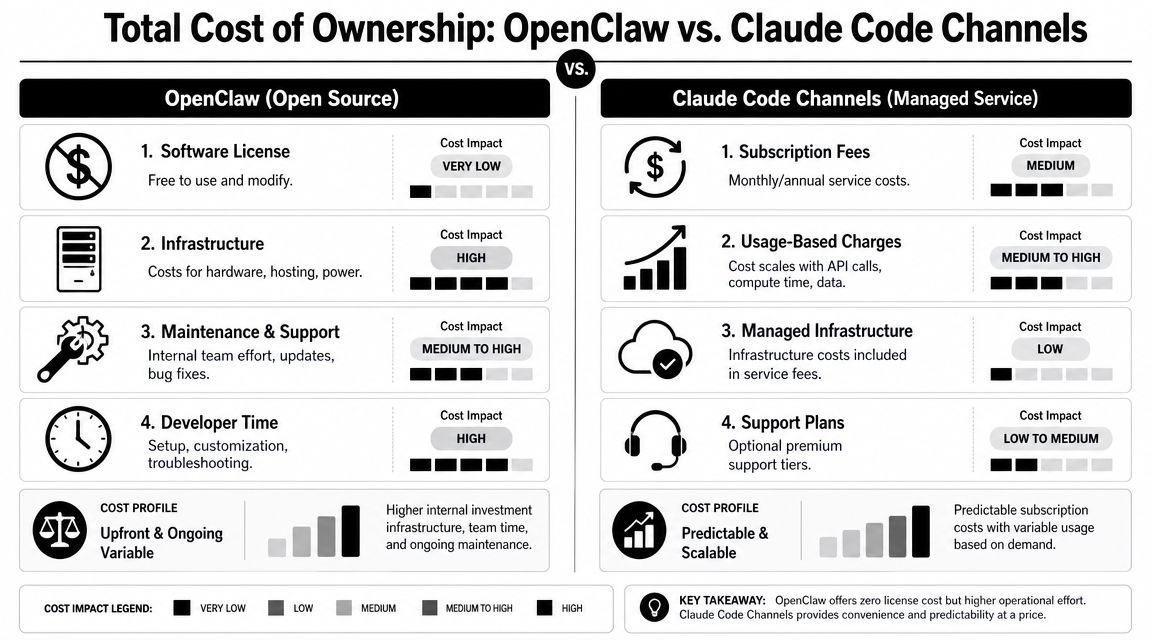
OpenClaw is free software with estimated hosting and model costs of $30 to $60 per month plus API usage, while Claude Code Channels is included with Claude subscriptions that start at $20 per month for Pro and $100 per month for Max, according to Verdent's OpenClaw and Claude Code cost comparison.
The sticker price is not the TCO
License price matters less than operating shape.
With OpenClaw, software cost is only the visible line item. The bigger questions are who owns deployment, who handles runtime incidents, who watches token consumption, and who absorbs the maintenance work that comes with an always-on agent system. For a team with platform engineers already on staff, that overhead may be acceptable because it buys control. For a product or ops team without that bench, it turns into a hidden tax.
OpenClaw TCO usually includes:
- Hosting for the runtime and supporting services
- Model API usage tied to actual agent activity
- Initial setup time from someone comfortable with deployment and configuration
- Ongoing maintenance for updates, patching, and reliability work
- Monitoring and incident response when workflows stall, loop, or fail without notification
Claude Code Channels has a simpler entry cost because the buying motion is subscription-first and setup is lighter. That makes it easier to approve for individuals and small teams. The trade-off shows up later if the workload needs persistent execution, broader environment control, or many isolated long-running workers. In those cases, lower startup cost does not guarantee lower ownership cost over a year.
Post April 2026 decision logic
The April 2026 change forced teams to separate two questions that were often blurred together before. What does access cost, and what does operation cost?
For OpenClaw, API-key usage remains viable, but the economics now depend more directly on runtime volume, token usage, and the number of active agents you keep alive. For Claude Code Channels, the economics are easier to predict at the individual user level, but the architecture is still optimized for a different operating model. That matters because bad fit creates redesign cost, and redesign cost belongs in TCO.
A practical decision framework looks like this:
- Choose Channels when the main goal is fast rollout, human-in-the-loop work, and low operational overhead.
- Choose OpenClaw when you need persistent agent behavior, infrastructure control, and are willing to fund the platform work behind it.
- Choose a managed OpenClaw layer such as Donely when you want OpenClaw's autonomy without inheriting the full DevOps burden yourself.
That third option deserves attention after the Anthropic change. Many teams still want the OpenClaw model, but they no longer want to staff the operational layer around it. In practice, that is the gap managed platforms are selling into. They reduce the labor component of TCO, which is often the largest cost in self-hosted agent deployments.
In persistent-agent systems, the expensive part is rarely the license. It is the combination of engineering time, operational risk, and redesign work when the first deployment choice does not match the workload.
Use Cases and Final Recommendations
Who should pick what
Pick Claude Code Channels if your workflow is centered on software delivery, local project context, and quick remote interaction. It's especially sensible for solo builders and small teams who already use Claude Code and want the shortest route to a working channel-based workflow.
Pick OpenClaw if the system must keep running independently, monitor external systems, maintain continuity, and support broader operational automation. That's the better fit for agencies, internal ops teams, and organizations that need a real agent runtime rather than a messaging extension to a developer session.
The practical recommendation
If I were advising a team with limited engineering bandwidth, I'd make the decision this way.
Start with Channels when the business goal is fast enablement and the human remains close to the loop. Start with OpenClaw when the business goal is autonomous continuity and the system must operate like an always-available worker.
The middle ground is where many teams live. They want OpenClaw's persistence and control without inheriting the full self-hosting burden. That's why managed operational layers around OpenClaw are becoming attractive. They address the part of OpenClaw that is a common challenge for teams, not the agent logic itself, but the infrastructure work around scaling, isolation, monitoring, and governance.
For most organizations, this isn't a pure tooling question. It's an operating model question. Choose the model first. The right product usually becomes obvious after that.
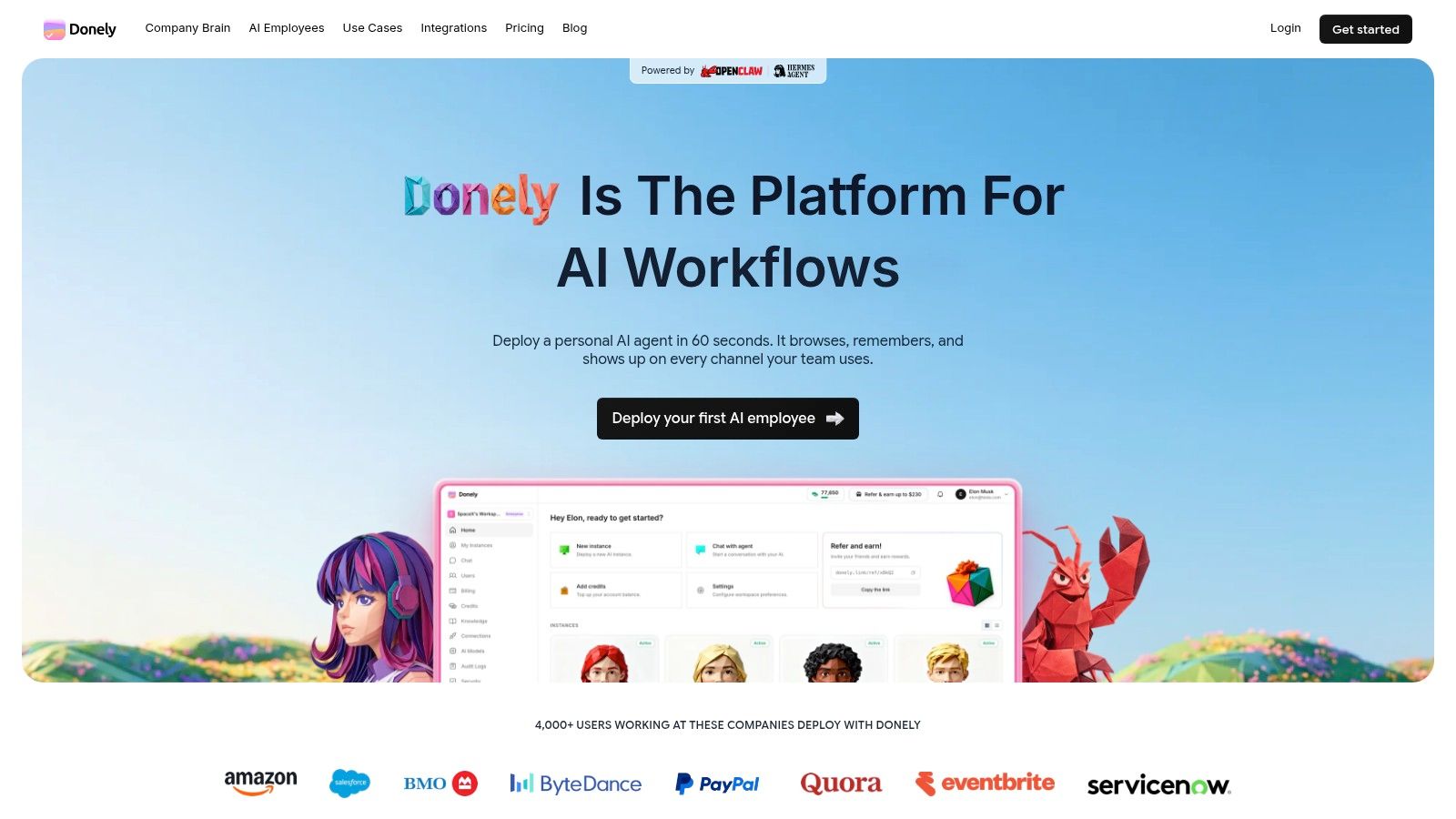
If you want OpenClaw's persistent-agent model without taking on the full DevOps burden yourself, Donely is worth a look. It gives teams a managed path to host, deploy, and govern OpenClaw-powered AI employees with isolated instances, centralized monitoring, and enterprise-friendly controls.