
You built a solid agent demo in Python. It can research, summarize, route a task, maybe even call a few APIs. Then the business asks the critical question: can it run all day, stay connected to Slack, handle retries, respect permissions, and avoid turning every failure into an engineering incident?
That's where most OpenClaw vs CrewAI comparisons go sideways. They treat both tools like direct substitutes. In practice, they usually solve different problems. One helps you coordinate agent logic. The other helps you run persistent agents in environments where uptime, integrations, and control matter.
If you're deciding between them, the useful question isn't which one is better. It's which layer of the stack you're solving for.
Table of Contents
- Introduction From Prototype to Production
- OpenClaw and CrewAI at a Glance
- The Core Difference Orchestration vs Execution
- Side by Side Comparison Key Decision Criteria
- Real World Use Cases When to Choose Which
- Recommendation Deploying OpenClaw Without the Headache
Introduction From Prototype to Production
A lot of teams hit the same wall. The prototype works on a laptop, or in a dev container, or from a single Python entry point. It looks impressive in a demo because bounded workflows are forgiving. The environment is controlled, the prompts are fresh, and nobody is asking how the agent behaves at 2 a.m. after a failed API call.
Production asks different questions.
Can the agent stay connected to Slack? Can it survive restarts? Can it log what it did, retry safely, and avoid touching systems it shouldn't? Can multiple teams use it without tripping over shared state? Those aren't prompt engineering problems. They're operating model problems.
That's why OpenClaw vs CrewAI needs a more precise lens. CrewAI is widely framed as a code-first Python framework for defining agents, tasks, and crews. OpenClaw is often framed as an always-on, channel-connected execution layer for agents that live inside real workflows. Those are adjacent concerns, not identical ones.
Most teams don't replace orchestration with execution. They discover they needed both, just at different moments of maturity.
When you're early, the biggest bottleneck is usually getting the agent to think coherently. When you're later, the bottleneck shifts. Now it's deployment, permissions, observability, and keeping the agent useful without creating operational risk.
That transition is where the primary comparison starts.
OpenClaw and CrewAI at a Glance
Teams usually get more clarity by comparing the job each tool handles, not by forcing both into the same product category.
| Category | CrewAI | OpenClaw |
|---|---|---|
| Primary identity | Code-first Python framework | Configuration-first execution platform |
| Best fit | Multi-agent reasoning and bounded workflows | Persistent, channel-connected agents |
| Setup style | Python environment and coded logic | Docker, markdown, or visual setup flow |
| Typical owner | Developer building agent workflows | Ops-minded team deploying live agents |
| Operational burden | User manages infrastructure | Designed around production execution |
CrewAI as the orchestration toolkit
CrewAI fits teams that want agent behavior defined in code. You model roles, task flow, delegation, and tool use inside Python, which makes it a strong option when the main problem is workflow design.
That matters during the prototype stage. Developers can change prompts, reorder steps, and test coordination logic without introducing a separate runtime layer too early. If the hard part is getting several agents to reason through a bounded process, CrewAI keeps that work close to the application and easy to iterate on.
OpenClaw as the execution platform
OpenClaw solves a different problem. Its center of gravity is long-running execution: agents that stay available, connect to external channels, and keep operating after the demo ends.
In practice, that means channel-connected agents, persistent state, and the operational controls needed to run them in a real environment. OpenClaw is the better fit when the question shifts from "how should these agents coordinate?" to "where does this agent live, how does it stay online, and who controls its access?"
The distinction is architectural. CrewAI is usually the layer for orchestrating work. OpenClaw is the layer for executing that work continuously inside business systems.
If you need context on why channel-connected agents behave differently from prompt-only workflows, this guide on what is conversational AI explained is a useful refresher. If you're already past evaluation and trying to run OpenClaw without owning the full deployment and operations burden, OpenClaw deployment options show where a managed platform becomes the practical next step.
The Core Difference Orchestration vs Execution
The cleanest answer to OpenClaw vs CrewAI is that you're usually comparing orchestration against execution.
Recent coverage makes this explicit. CrewAI is framed as the layer for multi-agent reasoning and task chaining, while OpenClaw is framed as the layer for running persistent agents with logging, retries, and permission control. Production adoption often needs both, not one pretending to be the other (Hire Overseas on OpenClaw vs CrewAI).
What orchestration actually means
Orchestration is the thinking layer. It decides which agent does what, how tasks are broken apart, how outputs move from one step to another, and how the system reasons through a bounded goal.
That's where CrewAI fits well.
If you're building a research pipeline, a planning system, or a multi-step content workflow, orchestration is the hard part. You care about roles, delegation, context passing, tool usage, and the shape of the process. A Python framework is a good fit because the workflow itself is part of your software.
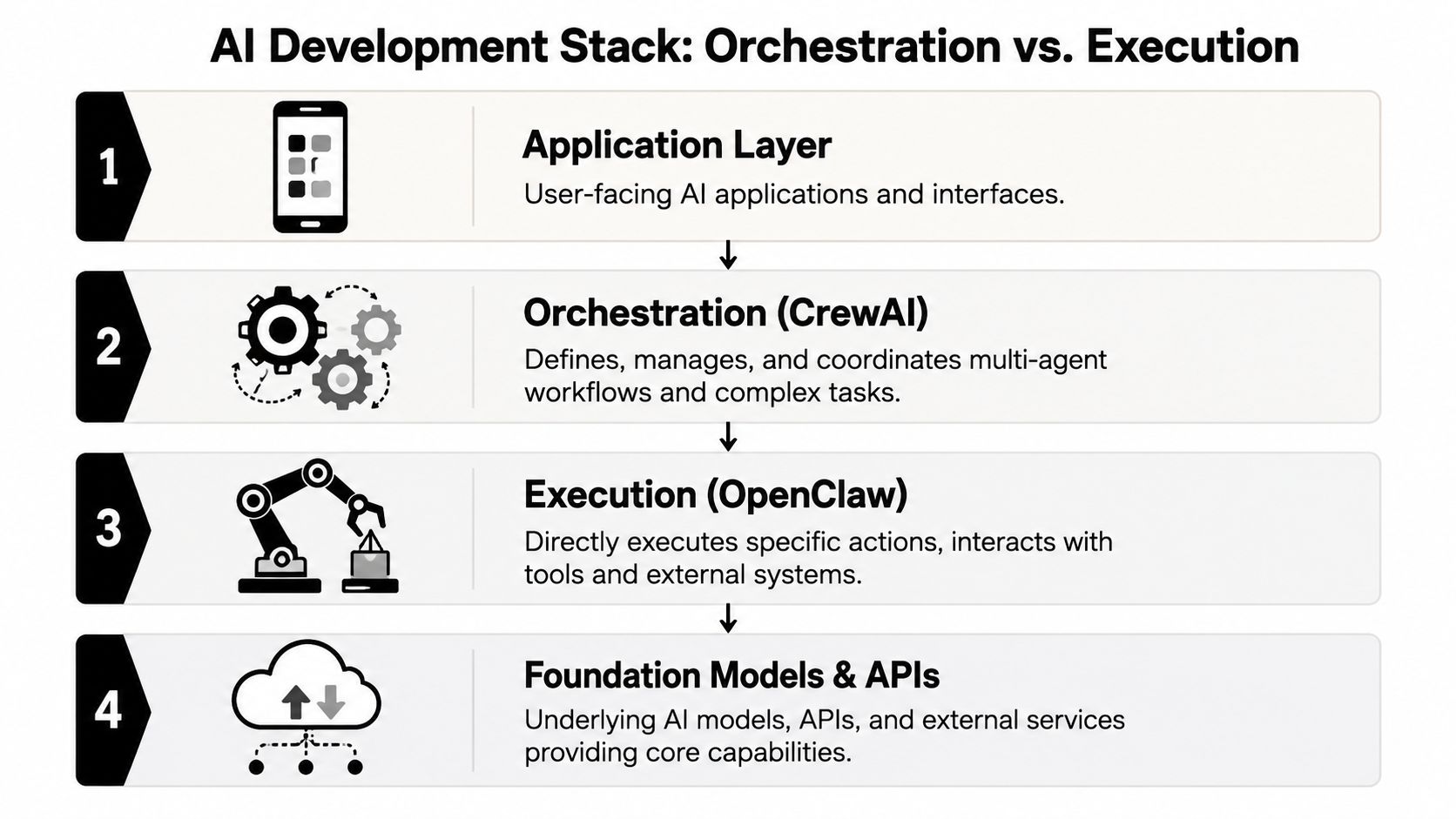
Architectural boundary: CrewAI helps agents decide what should happen. OpenClaw helps systems carry that decision out safely in production.
What persistent execution changes
Execution is the doing layer. It's the part that keeps working after the prototype is gone and the operator is no longer staring at logs in a terminal. The moment the agent must stay online, listen on a channel, recover from partial failures, and act across business systems, execution becomes its own problem.
That's where OpenClaw's positioning makes sense.
A persistent agent needs more than prompt logic. It needs lifecycle management, operational boundaries, and a deployment model that matches the fact that business workflows don't happen on demand from a notebook. They happen continuously, across systems, under permission constraints, with people expecting reliability.
A short walkthrough helps visualize where that stack separation matters in practice:
A lot of failed agent projects come from collapsing these two layers into one. Teams try to make the orchestration framework own production execution, or they expect an execution platform to replace careful reasoning design. Both create friction.
Side by Side Comparison Key Decision Criteria
The practical comparison gets clearer when you look at what each tool asks your team to own.
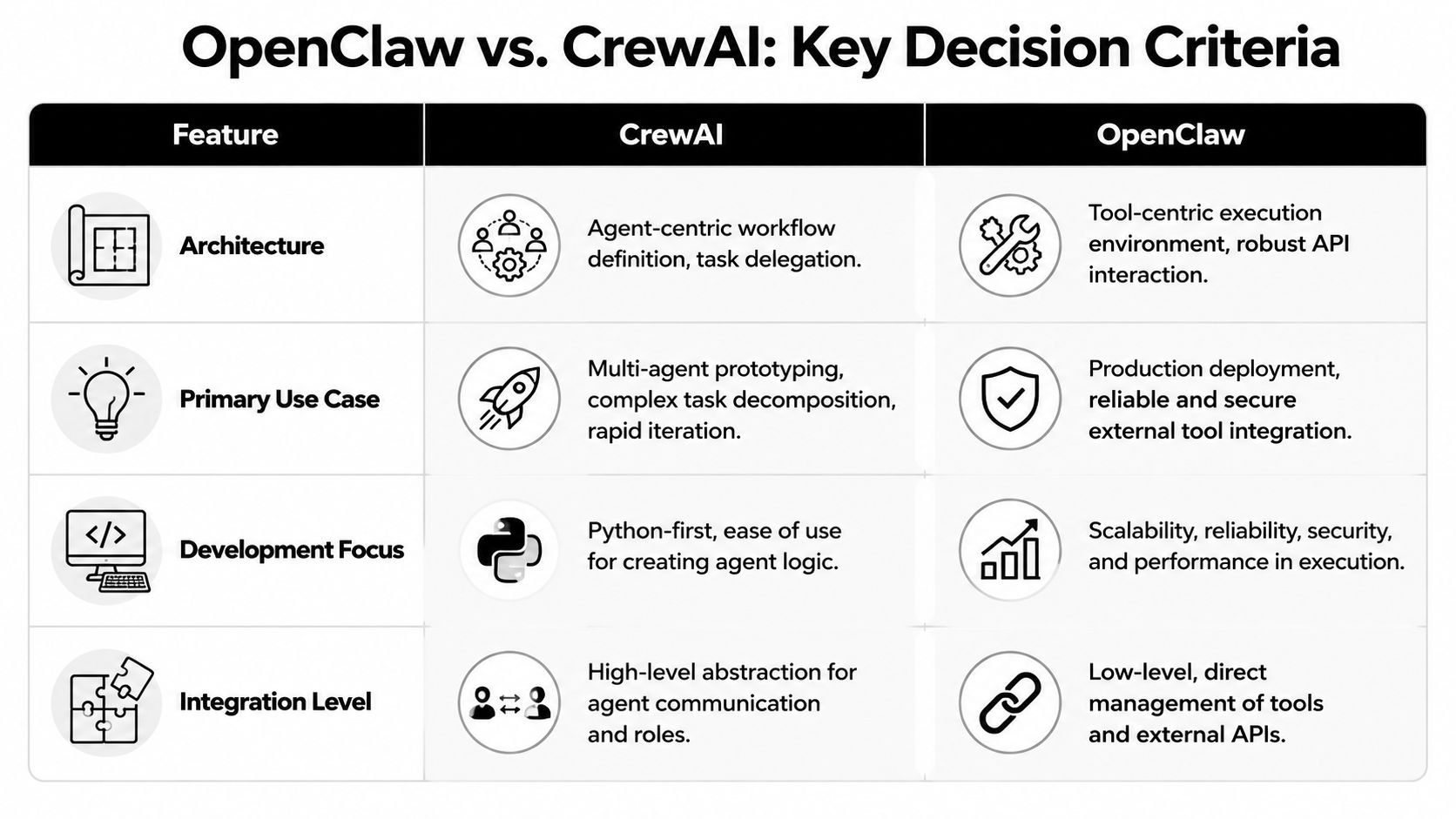
OpenClaw vs CrewAI Decision Matrix
| Criterion | CrewAI | OpenClaw |
|---|---|---|
| Core strength | Agent coordination and task chaining | Persistent execution across channels and tools |
| Project shape | App code and workflow logic live together | Runtime environment is a first-class concern |
| Setup path | Python, dependencies, coded workflow definitions | Config-first flow with Docker or visual setup |
| Change model | Developers edit code | Teams can operate through configuration |
| Best operational fit | Prototypes, internal workflows, bounded automation | Live business workflows, always-on agents, controlled execution |
Architecture and deployment
CrewAI behaves like a library. You install Python dependencies, define agents and tasks in code, then decide how to package, deploy, and monitor the result. That flexibility is useful, but it also means infrastructure responsibility stays with you.
OpenClaw is usually described as a configuration-first or no-code system. One comparison reported setup times of under 5 minutes for OpenClaw versus 15 to 30 minutes for CrewAI, while another reported under 10 minutes for OpenClaw (CrewClaw's comparison). The exact time matters less than the pattern. OpenClaw starts from the assumption that deployment itself should be simple enough for operators, not just developers.
For teams with limited platform bandwidth, that difference is decisive. A Python framework slots nicely into an existing engineering stack. A containerized execution platform reduces the amount of custom deployment work that keeps piling up later.
Developer and operator experience
CrewAI gives developers direct control. If you want to shape agent behavior in code, inspect task definitions, version everything in Git, and treat the workflow like an application module, it feels natural.
But the people who have to run the thing may experience it differently.
An operator doesn't usually want to own a Python environment, manually coordinate dependencies, and build custom wrappers around logging, recovery, and runtime behavior. They want a durable runtime. That's why the OpenClaw style appeals to operations teams and agencies. The system is more opinionated, but opinionated is often good when the goal is repeatable deployment.
The easiest way to pick between them is to ask who will own the day-two work. If the answer is “the platform or ops team,” execution concerns usually matter more than framework elegance.
Cost control also shows up here. Multi-agent workflows can become expensive when they loop badly or call heavyweight models for routine work. If you're tightening usage policies, this practical guide on how to reduce OpenAI API spend is worth reviewing before you lock in an architecture.
Integrations and extensibility
CrewAI is extensible the way most Python frameworks are extensible. You write code, wrap tools, call APIs, and build exactly what you need. That's powerful when your workflow is unusual or tightly coupled to internal systems.
OpenClaw's positioning leans the other direction. One comparison described a 1,200+ skill marketplace and a persistent runtime model built around business integrations and channel connectivity, which points to a broader operational surface area for out-of-the-box use. That doesn't automatically make it more flexible. It makes it more deployment-oriented.
So the trade-off is straightforward:
- CrewAI fits custom logic best when your main asset is the workflow design itself.
- OpenClaw fits repeatable integration patterns best when your main problem is getting agents to operate across tools consistently.
- The wrong fit shows up fast. If you keep writing operational glue around CrewAI, you may really need an execution layer. If you keep trying to force complex reasoning into a config-driven runtime, you may need an orchestration layer.
Scalability and state management
Many comparisons get fuzzy because “scale” means different things.
With CrewAI, scale often means more complex agent interactions. More roles, more tasks, more context passing, more model coordination. That can be productive, but it also increases the amount of governance you need around prompts, error handling, and tool usage.
With OpenClaw, scale is usually about operational breadth. One overview cited by a 2026 comparison estimated that small deployments with 1 to 5 agents may need about 2 to 4 GB RAM and 2 vCPUs on a single node, while 50+ agent setups scale to 16 to 32 GB RAM per node and can consume up to 100 GB total in Kubernetes clusters (Blink's comparison). Those figures reinforce the point that OpenClaw is being discussed as infrastructure, not just as a coding abstraction.
That distinction matters because state becomes an operational problem before it becomes a code problem. Persistent agents accumulate history, retries, permissions, channel events, and integration context. If your deployment has reached that point, you're no longer choosing a library alone. You're choosing an operating model.
Real World Use Cases When to Choose Which
The right choice gets obvious when you stop comparing features and start comparing failure modes.
Choose CrewAI when the hard part is reasoning
CrewAI is the better fit when your primary challenge is decomposing work across agents.
Examples:
- Internal research workflows: You want one agent to gather material, another to synthesize, and a third to format an answer for an analyst.
- Content and analysis pipelines: The value sits in structured collaboration across roles, not in staying connected to a messaging channel all day.
- Embedded agent logic inside a product: Your application already has its own infrastructure, and the agent layer is one module among many.
In these cases, a code-first Python framework is usually the right default. The workflow is bounded. The runtime is already under engineering control. The team wants flexibility more than platform conventions.
Choose OpenClaw when the hard part is operations
OpenClaw is the better fit when the reasoning isn't the risky part. The risky part is keeping the agent alive, connected, governed, and useful in a real business environment.
Examples include a support agent living in Discord or Slack, a sales assistant watching systems for follow-up conditions, or an internal agent that needs logging, retries, and controlled access around business actions. The moment your problem statement includes “always on,” “channel-connected,” or “safe execution,” you're in execution territory.
That's also where integration breadth starts to matter. A production setup gets easier when the runtime is built to connect across tools from the start. For teams planning around channel and app connectivity, agent integration options are often more relevant than another round of prompt tuning.
Use both when the system must think and act
The hybrid model is often the most mature architecture.
Use CrewAI as the reasoning layer. Let it coordinate specialized agents, shape decisions, and produce structured output. Then hand the result to OpenClaw for the execution layer, where persistence, permissions, retries, and operational safeguards belong.
If the agent is allowed to affect customer records, support queues, or revenue workflows, separating the thinking layer from the doing layer is a safer design.
That architecture also keeps teams honest. Engineers can improve reasoning without constantly reworking the runtime. Operators can improve governance without rewriting agent logic.
Recommendation Deploying OpenClaw Without the Headache
OpenClaw vs CrewAI isn't a winner-take-all decision. CrewAI is the practical pick when you need a developer-controlled orchestration framework. OpenClaw is the practical pick when you need persistent execution in production.
The harder question comes after that. If OpenClaw is the right execution engine for your use case, how much of the hosting and operational burden do you want to own?
Where self-hosting starts to hurt
Self-hosting sounds straightforward at first. One instance, one team, one deployment. Then the workload expands.
Now you need separate environments for internal ops, customer-facing agents, and maybe client-specific deployments. You need access boundaries, billing visibility, logs that people can use, and a way to roll changes out without turning every update into a mini migration project. None of that changes the value of OpenClaw itself. It changes the amount of DevOps work around it.
That's the point where a managed layer becomes rational, especially for agencies, founders, and ops teams that don't want to build a platform around the platform.
When a managed layer becomes the sensible move
One option in that category is managed OpenClaw hosting. Donely provides a multi-instance platform for deploying and managing OpenClaw-based AI employees, with isolated instances, per-instance RBAC, centralized monitoring, unified audit logs, and built-in integrations across business tools and messaging channels.
That matters because the operational boundary doesn't disappear once you've chosen OpenClaw. It gets sharper. Persistent execution still needs governance, observability, tenant isolation, and a deployment model that can grow from one agent to many without forcing a rebuild.
If you're a solo builder, you may still choose to self-host for control. If you're an agency or internal platform team, the equation changes fast. Once you're juggling multiple instances, multiple owners, and multiple environments, a managed platform often becomes the lower-risk path.
If OpenClaw is the right execution layer for your stack, Donely is a practical way to run it without absorbing the full DevOps burden yourself. It gives teams a single place to deploy, isolate, monitor, and govern AI employees as they move from prototype to real production use.